
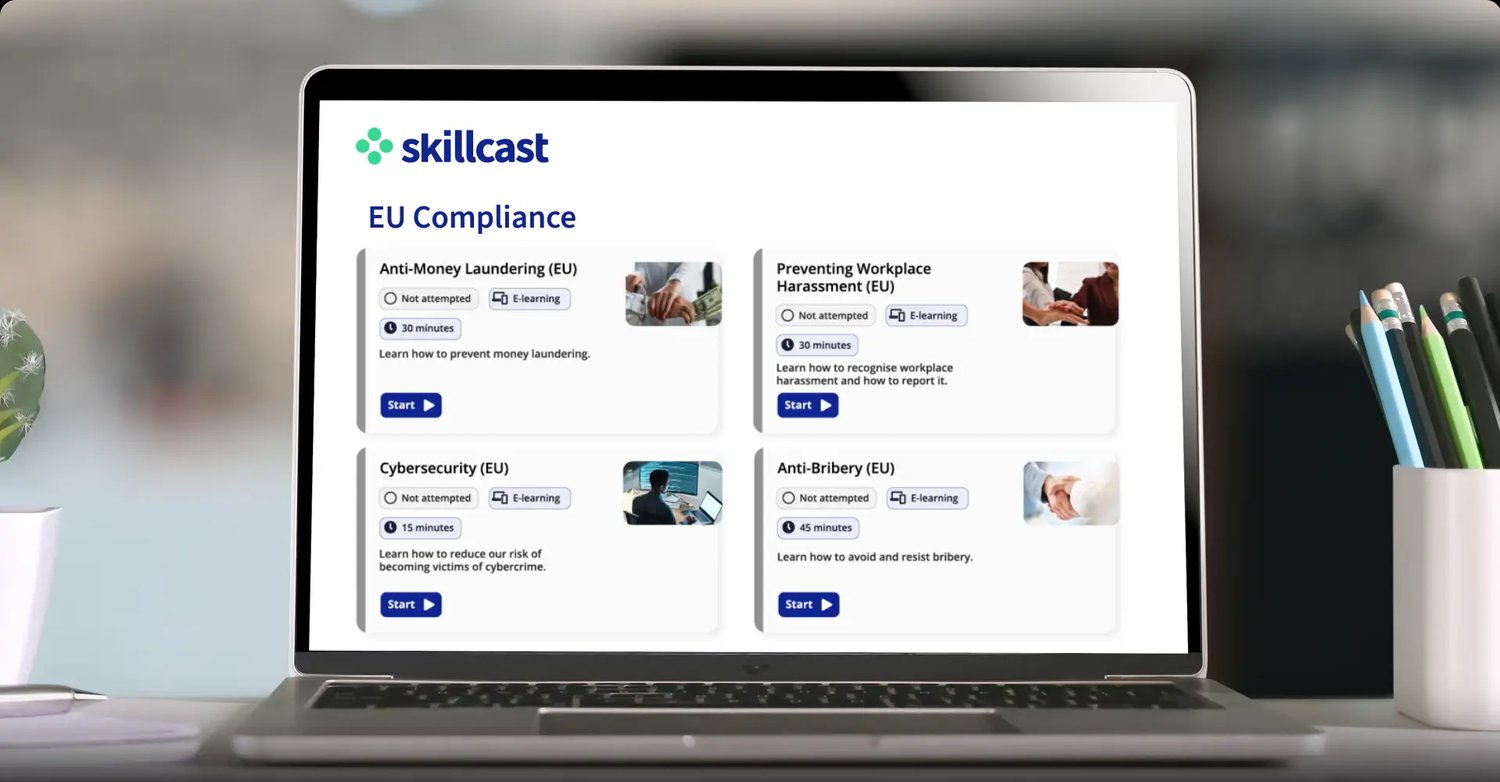
EU compliance e-learning that's simplified and scalable
The EU Compliance Library is built specifically around guidance and scenarios that cover core EU directives, ensuring every employee receives the same standardised training, regardless of location. Streamline compliance training and ensure consistency by:
-
Covering EU-specific regulatory frameworks
-
Providing standard learning in English, German, French and Dutch
-
Standardising expectations across teams
-
Centralising reporting and compliance oversight

Made for:
Compliance & Legal
Cut regulatory risk without adding complexity and keep your workforce consistently compliant across the EU.
L&D, HR & Training
Deliver a standardised EU-wide training programme with role- or region-based learning in employees’ preferred languages, using centralised tracking to monitor progress and maintain full visibility.
What you'll find in our EU Compliance course library

Embargoes and Sanctions
EU restrictive measures are adopted centrally but enforced by member states, which means penalties and expectations vary depending on where your entity sits. Staff working across borders need one consistent standard to apply. Training them together gives your group a defensible baseline and reduces the risk of an entity in one jurisdiction quietly operating to a weaker interpretation than another.

Market Abuse Regulation
MAR applies to anyone in possession of inside information, not only those trading. Support functions, projects teams and assistants routinely hold information that would move a price. Training staff across the organisation removes the assumption that the rules belong to the desk, and it gives your firm evidence of the preventative measures MAR expects issuers and firms to have in place.

Environmental, Social and Governance (ESG)
EU disclosure requirements have raised the evidential bar considerably, and vague claims now carry regulatory as well as reputational risk. The people making those claims are often not the people writing the reports. Training staff on the substance behind your ESG position protects the accuracy of what customers and counterparties are told, which is where most greenwashing exposure actually begins.

Conflicts of Interest
EU conduct regimes place explicit obligations on firms to identify and manage conflicts rather than simply disclose them, and supervisors test the register as evidence. Conflicts go unreported because staff do not recognise them, not because they hide them. Lowering that recognition threshold across the business is what turns your conflicts policy into something that functions.
_ID.webp)
Directive on Administrative Cooperation in the Field of Taxation (DAC6)
Member states implement DAC6 with their own deadlines and penalties, so an EU group faces several versions of the same obligation. The reporting burden frequently lands on intermediaries who were not the architects of the structure. Training the staff who see these arrangements first is the only practical way to meet short reporting windows across multiple jurisdictions.

Fraud Prevention
Cross-border payment flows and multilingual operations give fraudsters room to work, particularly in invoice redirection and impersonation attempts that rely on nobody wanting to question a request. Awareness across all staff is the control that catches these, because the approval process itself is what the attacker is using. Consistent training gives every entity the same baseline.

Information Security
For EU organisations, information security sits alongside GDPR accountability and, for many, NIS2 obligations, both of which look at staff awareness directly. Technical controls do not cover the point where a person decides to open an attachment or share a file. Training the workforce provides the layer that regulators and enterprise customers now expect to see documented.

Responsible Use of Artificial Intelligence
The EU AI Act introduces obligations that vary by risk category, and staff adopting tools independently will not know which category they have just moved into. Most AI risk enters an organisation through individual enthusiasm rather than formal procurement. Training everyone gives you a chance to catch that before an unapproved tool is processing customer data or shaping a decision that affects someone.

Anti-Money Laundering and Counter-Terrorist Financing
The EU framework has been tightening steadily, with more prescriptive due diligence expectations and a growing focus on beneficial ownership. Obliged entities extend well beyond banking. Training staff across the business gives your organisation the human judgement layer that automated screening cannot replicate, and satisfies the ongoing training requirement that supervisors examine directly.

Bribery Prevention
EU member states enforce corruption law nationally, with penalties and prosecution appetite varying considerably between them. Companies operating across several markets cannot rely on local practice as a guide. A single internal standard, understood everywhere, protects the group and gives staff something firm to fall back on when a counterparty applies pressure that local custom appears to permit.

Competition Law
The European Commission can fine up to 10% of worldwide group turnover, and national authorities pursue cases in parallel. Damages claims from customers follow the decision. Most infringements start informally, in a conversation nobody thought was significant. Training commercial and pricing staff on where the boundary sits is the only control that operates at the moment it is needed.
-ID.webp)
General Data Protection Regulation (GDPR)
Subject access requests arrive without warning, often from employees or customers in dispute, and the one-month clock starts on receipt by anyone. Mishandled requests attract complaints to a supervisory authority quickly. Training the whole workforce rather than the data protection team alone means requests get recognised and routed on the day they arrive, which is where most of the risk sits.

Harassment in the Workplace
EU member states implement equal treatment and workplace dignity requirements through national law, so the legal detail varies while the expected standard does not. Multinational employers are judged against their own stated policy across every location. Consistent training establishes one behavioural standard, and it gives managers a common reference point when addressing conduct that has not yet become a formal complaint.

Responsible Use of Social Media
Under GDPR, most social media content involving identifiable people counts as personal data, which brings employee posts about colleagues and customers into scope. Content also crosses borders instantly and cannot be recalled. Setting clear expectations protects individuals from decisions made quickly, and protects the organisation from having to explain a post it never approved.
-ID.webp)
Digital Operational Resilience Act (DORA)
DORA replaced a patchwork of national guidance with directly applicable requirements and hard reporting timeframes, and supervisors have been explicit that management bodies carry responsibility for it. The obligations sit with people across technology, procurement, operations and governance. Training all of them is what allows a firm to evidence compliance rather than describe an intention to comply.
-ID.webp)
Diversity, Equity and Inclusion (DEI)
EU equal treatment directives are implemented through national law, so the legal detail varies while the expected standard does not, and pay transparency requirements are raising the evidential bar further. Inclusion is produced in everyday interactions rather than policy documents. Training the workforce consistently gives a multi-country organisation one behavioural standard to hold people to.

Cybersecurity
EU organisations increasingly sit within NIS2 or DORA scope, both of which treat staff awareness and incident reporting as explicit obligations rather than good practice. Reporting timeframes are short and start when the incident is detected. Training the workforce shortens the gap between something looking wrong and someone raising it, which is what makes those deadlines achievable.

Whistleblowing
The EU Whistleblowing Directive requires organisations above a size threshold to operate internal reporting channels with defined timeframes and protection against retaliation, implemented through national law. A compliant channel that staff do not trust receives nothing. Training the workforce on both the process and the protection is what converts the legal requirement into a functioning source of information.

Modern Slavery
EU corporate sustainability due diligence requirements are extending obligations further into supply chains, with reporting that invites scrutiny of what firms actually did. Exploitation concentrates in agriculture, construction, logistics and cleaning. Training staff who procure, inspect or manage contracts gives an organisation visibility where a supplier declaration cannot.

Counter-Proliferation Financing
EU export control and sanctions frameworks intersect with proliferation financing in ways that catch firms handling dual-use goods, shipping or trade finance, often without them realising the connection. Indicators differ from standard laundering typologies. Training staff on what distinguishes PF is what allows an EU group to demonstrate it has assessed the risk rather than assumed it away.

Gifts and Hospitality
Gifts and hospitality can create a risk of actual or perceived bribery if not handled correctly. This training helps employees assess the appropriateness of gifts and hospitality, ensuring transparency, proportionality and compliance with anti-bribery policies.

Risks in the Use of AI
This training highlights how AI can be used effectively while identifying and addressing potential risks.

Understanding Bribery
Bribery is not always obvious and can take many subtle forms, from lavish gifts to preferential treatment. This training helps employees recognise bribery risks, understand legal responsibilities and apply measures to prevent and report corrupt practices.

Understanding ESG
Companies are increasingly expected to integrate environmental, social and governance principles into their operations to attract investors. This training helps employees understand environmental, social and governance factors, assess existing policies and contribute to a strategy that aligns with investor expectations and legal requirements.

Understanding Information Security
Information security is essential to protect sensitive business and customer data from unauthorised access, breaches and cyber threats. This training helps employees understand their role in safeguarding information, following security policies and identifying potential risks.

Understanding Modern Slavery
Modern slavery remains a persistent, inhumane practice affecting millions through forced labour, trafficking and exploitation. This training helps employees understand the signs of modern slavery and their duty to report any suspected cases in our operations and supply chains.

Understanding Sanctions
Sanctions restrict business dealings with specific individuals organisations or countries to support global peace, human rights and crime prevention. This training helps employees understand the types of sanctions, their impact on business activities and their role in ensuring compliance.

Understanding Sexual Harassment
Sexual harassment is unwanted behaviour of a sexual nature that violates a person’s dignity or creates an intimidating, hostile or offensive environment. This training helps employees recognise different forms of sexual harassment, understand its impact and follow workplace policies to prevent and report it.

Understanding Terrorist Financing
Terrorist groups rely on financial support from various sources, both intentional and unintentional. This training helps employees understand how terrorists secure funds, recognise red flags of terrorist financing and take action to prevent financial crime.

Whistleblowing
Whistleblowing is the act of reporting wrongdoing such as fraud, bribery or safety breaches to protect an organisation and its stakeholders. This training helps employees understand their right to report misconduct confidentially, the protections in place for whistleblowers and the importance of raising concerns promptly.

Understanding Conflicts of Interest
Conflicts of interest arise when personal, professional or financial interests compromise impartiality and decision-making. This training explores common scenarios and best practices for identifying, disclosing and managing conflicts to maintain fairness and integrity.

Understanding Fraud
Fraud is a deliberate act of deception aimed at obtaining an unfair advantage, often causing harm to individuals or organisations. This training helps employees recognise different types of fraud, understand its impact and take steps to prevent and report fraudulent activity.

Understanding Harassment
Harassment is unwanted conduct that violates a person’s dignity or creates an intimidating or offensive environment. This training helps employees recognise different forms of harassment, understand its impact and take action to prevent and report it in the workplace.

Understanding Market Abuse
Market abuse distorts financial markets and disadvantages investors. This training explains insider dealing, unlawful disclosure and market manipulation and how to prevent them.

Understanding the GDPR
The General Data Protection Regulation (GDPR) sets out key principles for handling personal data and protecting individuals' rights. This training helps employees understand GDPR requirements, their responsibilities in processing data and how to prevent data breaches that could lead to reputational and financial consequences.

Spot a Phishing Attempt
Phishing emails are fraudulent attempts by cybercriminals to trick individuals into revealing sensitive information. This training helps employees recognise phishing attempts, identify red flags in emails and take steps to protect personal and company data from cyber threats.

Money Laundering Red Flags
Detecting and reporting money laundering red flags is essential for maintaining anti-money laundering (AML) compliance. This training helps employees recognise suspicious transactions, assess potential risks and report concerns to the appropriate authorities.

The Three Stages of Money Laundering
Money laundering is the process criminals use to disguise illicit funds as legitimate income through placement, layering and integration. This training helps employees recognise the stages of money laundering, identify suspicious financial activities and take appropriate action to prevent financial crime.

Business Email Compromise
Business Email Compromise (BEC) is a targeted cyberattack where criminals impersonate executives or hack accounts to steal money or sensitive information. This training helps employees recognise different types of BEC scams, understand the risks and apply verification steps to prevent fraud.

Anti-competitive Agreements
Competition laws ensure fair business practices by preventing anti-competitive agreements that restrict market competition. This training explains the risks of horizontal and vertical agreements, how to recognise illegal collusion and what to do if you encounter anti-competitive behaviour.

EU AI Act
Most AI reaches a business through individual enthusiasm rather than procurement, which means a team can move into a restricted category without anyone deciding to. Recruitment screening and employee monitoring both fall within the Act's high-risk classification. Training staff before the tools arrive keeps an organisation's AI position deliberate rather than discovered during an audit.

EU Pay Transparency Directive
The Directive shifts the burden of proof onto the employer, so a pay decision now has to be defensible on the record rather than in recollection. Pay secrecy clauses stop being enforceable, and candidates gain a right to salary information before interview. Managers create most of that exposure in ordinary conversations, which is where the training has to land.

Why choose Skillcast to deliver your compliance e-learning with a fully managed service?
The Skillcast Portal offers a complete compliance platform to handle your e-learning. It has the ability to add purpose-designed software that improves your policy management, staff disclosures, compliance registers, and other compliance tools. Available in three tiers - Standard, Enhanced, and Premium - Skillcast Portal packages elevate the way you deliver compliance training to your staff, with all plans including our five-star managed service and security as standard.