

Quarterly insights from Skillcast's AI Adoption and Compliance Report
Skillcast surveyed 500 full-time UK employees working across banking/financial services, government and public sector, legal/law, insurance, and the compliance sectors to understand how organisations are adapting to the rapid adoption of AI in the workplace.
The research explored three core themes:
- Adoption - how frequently are employees actually using AI in their day-to-day work?
- Trust - do employees believe that AI outputs are accurate and reliable?
- Governance - have organisations provided the policies, framework, and training employees need to use AI responsibly?
The survey found that:
-
75% of UK professionals use AI at least weekly, and half use it multiple times a day.
-
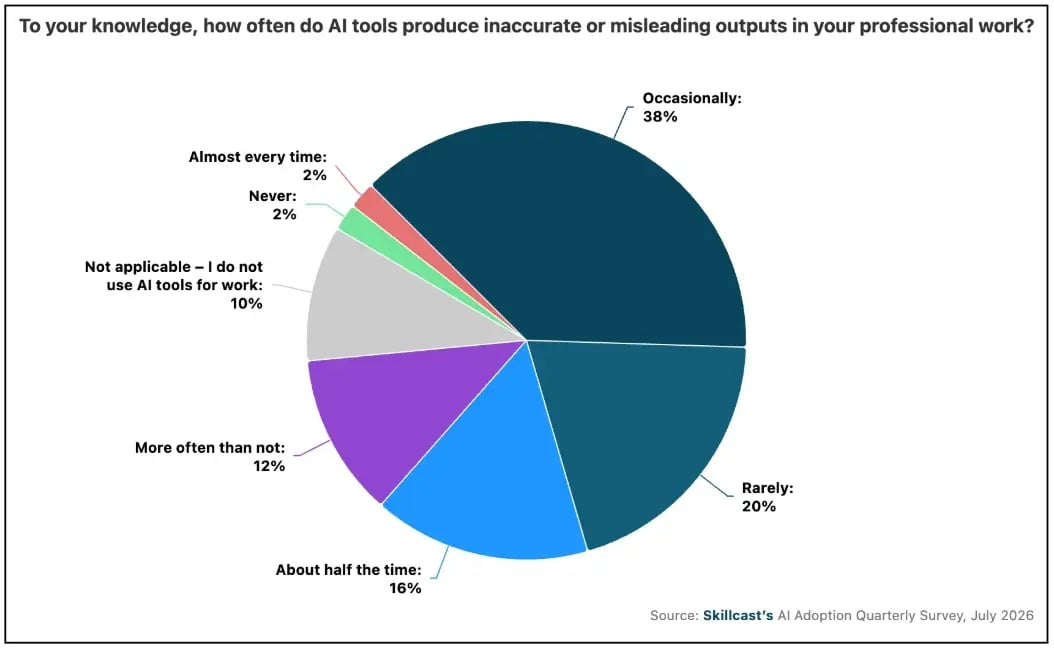
68% say AI produces inaccurate or misleading outputs at least occasionally - only 2% say it never does.
-
Almost half (48%) either have no AI policy at work, or don’t know if one exists.
-
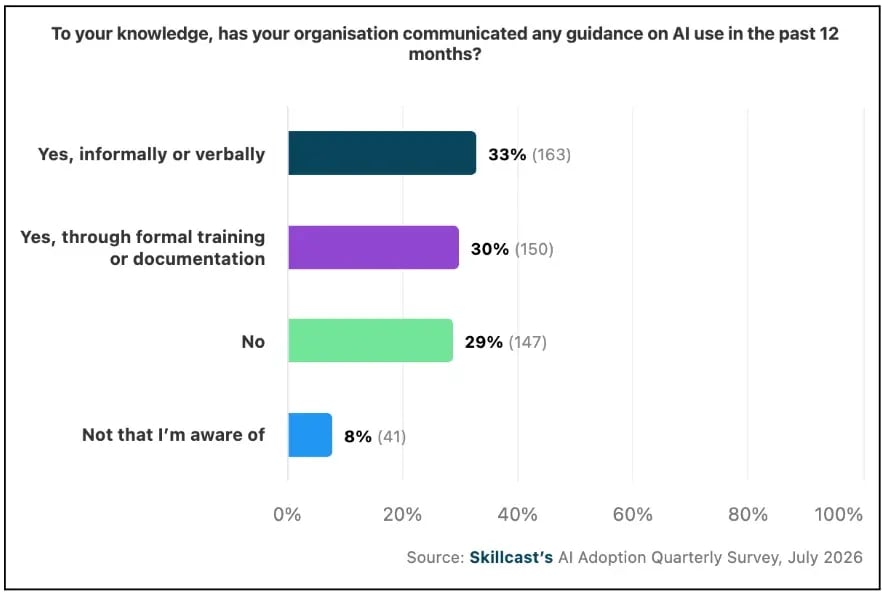
69% have not received any formal AI training during the past 12 months, with the majority of guidance delivered informally or verbally.
-
Employees are more concerned about inaccurate AI outputs than job displacement, with accuracy and data security ranking as their biggest concerns.
AI has become part of the day-to-day, but AI governance hasn’t kept pace
Use of AI in the workplace has rapidly evolved from being an ‘experimental’ technology into an everyday workplace and personal tool. Across industries, organisations are increasingly using AI to support everyday work, from recruitment and retention to automating routine tasks.
This growing adoption comes as AI becomes a strategic priority at a national level with the recent appointment of the UK’s first-ever Minister of State for Artificial Intelligence, Kanishka Narayan, who assumed office on 20 July 2026.
The benefits are clear. Used responsibly, AI tools have the potential to improve productivity, reduce administrative burden, and help employees make informed decisions.
However, widespread adoption without clear governance, effective oversight, and appropriate training introduces significant operational, compliance, and reputational risks for companies.
Use of AI in a typical working day
Our survey found that AI is now firmly embedded in the workday. Fewer than 2% of respondents reported being prohibited from using AI in the workplace. Instead:
-
Three-quarters (75%) reported using AI at least weekly.
-
50% use it at least once a day.
-
More than three in 10 employees say they use AI tools multiple times a day.
-
Just 11% reported never using any form of AI in a typical working day.
Governance and oversight of AI usage have been left behind
The governance needed to support AI usage has clearly not followed a similar adoption pace. Nearly half (48%) of the total respondents either don’t have a clear, accessible AI usage policy at work or aren’t aware of one being in place.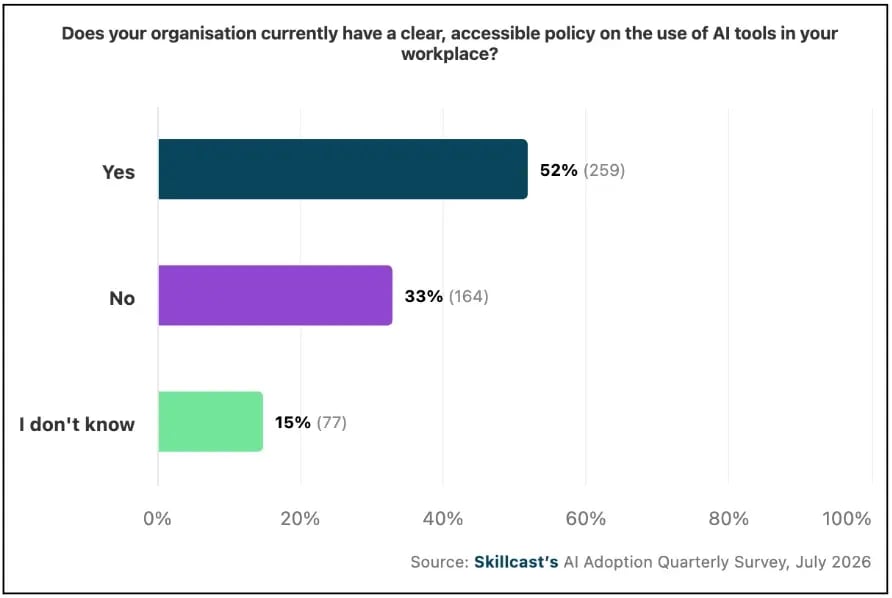
Meanwhile, almost seven in ten full-time employees (69%) reported not having received any formal AI training or guidance in the past 12 months.
Even where guidance exists, it is often informal, with 33% saying AI guidance had been communicated verbally or informally rather than through structured training or documented policies.
Employees don't fully trust AI outputs
Despite widespread adoption, trust in AI outputs also remains cautious. More than two-thirds of employees (68%) say AI produces inaccurate or misleading responses at least occasionally.
To that, 30% of respondents say it happens more often than not, about half the time, or almost every time AI tools are used.
The UK has a growing AI governance gap
Taken together, these findings suggest that many organisations have embraced AI tools more quickly than they’ve established clear controls and policies on how to use them responsibly.
In fact, our survey suggests that many employees are currently making workplace decisions with AI without clear policies, formal training or confidence that the outputs can always be trusted.
Without clear governance and AI compliance training, organisations risk employees misusing AI-generated information or placing undue trust in inaccurate outputs. This can result in biased decision-making, privacy breaches, regulatory non-compliance and reputational damage.
The risks are also no longer theoretical:
-
Research by Netskope found that the average organisation experiences 223 incidents every month involving employees uploading regulated or sensitive data into GenAI tools, accounting for 54% of all flagged GenAI policy violations.
-
Thames Valley Bank experienced one of the UK’s first major AI-related compliance breaches after customer names, risk profiles, and transaction data were uploaded to an unauthorised public generative AI platform - exposing sensitive information belonging to more than 75,000 customers.
-
According to IBM’s Cost of a Data Breach Report (2025), 97% of organisations experienced an AI-related security incident during the previous year. Organisations without effective AI access controls and governance also incurred significantly higher breach costs, averaging almost £500,000 more per incident.
AI adoption vs governance by sector
Sector scorecard
Percentage of respondents |
||||
| Banking and Financial n=148 |
Government and Public Sector n=159 |
Retail n=133 |
Insurance, Legal, and Compliance n=60 |
|
| Adoption - use of AI at least daily during a typical working day |
72% |
45% | 51% | 40% |
| Trust - say AI is wrong more often than not, about half the time, or almost every time | 32% | 24% | 37% | 27% |
| Governance - Report not knowingly having a clear, accessible AI policy at work. | 39% | 50% | 58% | 45% |
| Governance - Report not knowingly having any training/guidance on AI use in the past 12 months | 20% | 34% | 49% | 43% |
n = refers to the sample size of respondents
Insight: Banking is leading AI adoption, but governance is trying to keep up
Respondents in the banking and financial services sector had the highest AI use of any industry surveyed. Almost three-quarters (72%) of respondents use AI at least once during a typical working day:
- Multiple times a day: 53%
- Once a day: 19%
- A few times a week: 18%
- Occasionally: 9%
- Never: 1%
- I am not permitted to use AI in my workplace: 1%
The frequency of use reflects the growing role AI plays across financial services, from customer support to fraud detection. As AI becomes embedded within regulated business processes, ensuring employees understand how to use these tools responsibly is critical.
Encouragingly, banking also demonstrated the strongest governance maturity: 61% confirm they have a clear, accessible AI policy at work, and only 1 in 5 (20%) report receiving no guidance on AI use during the past 12 months.
However, governance still has room to mature. Nearly one in three banking respondents (32%) say AI produces inaccurate or misleading outputs at least half the time, while accuracy remains their biggest personal concern when using AI at work.
This suggests that even in sectors heavily investing in AI governance, employees continue to recognise the importance of human oversight and critical judgement.
The City Skills Compact
The government’s new City Skills Compact (announced 14 July 2026) acknowledges that AI capability is becoming a core workplace skill across financial services. By encouraging firms to develop structured AI training programmes and assigning greater organisational accountability, the initiative reflects a growing recognition that AI governance is a business-wide compliance challenge.
However, the real measure of success won’t be course completion rates alone, but whether organisations can equip their workforce to use AI responsibly and with sound judgement - recognising its limitations, understanding regulatory requirements, and knowing when human oversight should take precedence.
Insight: The government and public sector have been slower to adopt AI
Government and public sector employees report the lowest level of daily AI use of any sector analysed, with 45% of employees using AI during a typical working day. Given the sector’s heightened responsibilities around public accountability, data protection and procurement, a more measured pace of adoption is unsurprising.
However, slower adoption hasn’t translated into stronger early governance.
Half of respondents (50%) either don’t have a clear AI policy or are unaware of one existing, while one in three (34%) report not knowingly receiving guidance on AI use during the past year.
While a more cautious approach may reduce immediate exposure to AI-related risks, it also creates the challenge of ensuring frameworks are in place before adoption inevitably accelerates. Public sector organisations have an opportunity to build clear governance and oversight of AI tools proactively, rather than retrospectively.
Insight: Retail combines high AI adoption with the weakest governance
Retail demonstrates the clearest gap between AI adoption and organisational governance.
Over half (51%) of retail employees report using AI daily, suggesting AI is already supporting a wide range of customer service, marketing, merchandising, and operational tasks.
Yet oversight and guidance significantly lag behind:
- Nearly six in ten respondents (58%) report having no AI policy, or are unaware if one exists.
- 49% say they’ve received no guidance or training during the past year, the highest proportion of any sector surveyed.
Retail employees are also the most likely to question AI's reliability. More than one-third (37%) say AI produces inaccurate or misleading outputs at least half the time, the highest figure recorded across all sectors.
Insight: Insurance and legal remain cautious, but face the same AI policy challenge
Insurance, legal and compliance professionals report the lowest overall levels of AI adoption after the public sector, with four in ten (40%) using AI daily.
This relatively cautious approach likely reflects the highly regulated nature of these professions, where accuracy, confidentiality and professional accountability are critical.
Despite slower adoption, governance also has a way to go. Almost half (45%) either lack a clear AI policy or are unsure whether one exists, while 43% report receiving no AI guidance during the previous year.
Respondents in the group also view the risks of AI differently from those in other sectors. While accuracy remains important, reputational risk ranks as their lowest concern, suggesting that respondents are more focused on operational, legal, and regulatory considerations.
Why are employees worried about AI?
Across all sectors, employees ranked their concerns as follows:
- Accuracy of AI outputs
- Data privacy and security
- Job security or displacement
- Regulatory or legal risk
- Lack of clear guidance or policy from my employer
- Reputational risk to my organisation or me
- Ethical concerns around bias or unfairness
This suggests that rather than fearing the technology itself, there is confidence in using AI, but little trust in it. Employees are overwhelmingly concerned about the consequences of relying on inaccurate information and mishandling sensitive data, ahead of any job security or displacement concerns.
What does an AI governance gap actually look like?
An AI governance gap doesn’t necessarily mean employees are using AI irresponsibly.
Instead, it means organisations have yet to provide the policies, training, and oversight needed to ensure AI is used consistently across the business. Without these foundations, employees may make different judgements about when AI is appropriate, use unapproved tools, or place too much confidence in AI-generated outputs.
Key steps organisations should take to close the governance gap
Closing the governance gap means giving employees both the confidence and the guardrails to use AI effectively. That requires more than a written policy - but practical training, clear accountability and ongoing review as AI technologies continue to evolve. As a standard, employers should be looking to:
-
Develop a clear AI policy that explains which tools employees can use, accepted use cases, and oversight responsibilities. Employees shouldn't be left second-guessing what constitutes responsible AI use.
- Provide role-specific AI compliance training so employees understand both the opportunities and risks relevant to their work and embed data protection principles.
- Define and build human oversight into AI workflows by ensuring appropriately trained people review important decisions involving customers, employees, or regulated information.
- Review governance regularly as AI technologies, regulations, and organisational use cases continue to evolve.
- Turn AI governance into everyday practice by embedding AI-powered compliance solutions, such as Aida, that give employees instant access to company policies, compliance guidance, and trusted answers exactly when they need them.
Turning AI governance into everyday practice with Aida
The findings point to a clear need for organisations to make responsible AI use part of everyday working practice; not simply something covered in a policy or annual training course. When it comes to adopting AI in compliance, assurance matters more than automation.
That’s why organisations need more than just another AI tool. They need a trusted, connected AI solution that fits seamlessly into the way they manage compliance.
Meet AidaBuilt for the unique demands of compliance, Aida combines 25 years of regulatory expertise with AI-powered innovation in a single intelligent solution. From policy guidance and conversational learning to course editing and translation, Aida helps organisations deliver faster, more relevant compliance training while maintaining full human oversight, leading to stronger engagement, better decisions and greater confidence that compliance risks are being effectively managed. |
This approach addresses several of the concerns highlighted in our research.
-
Accuracy: Aida builds on Skillcast’s trusted, expert-reviewed compliance content, helping organisations use AI without relying on unverified, open-ended outputs.
-
Trust: Aida combines regulatory expertise with AI-powered innovation, giving organisations greater confidence in the relevance and reliability of their compliance training.
- Relevance: Organisations can use Aida to edit, personalise and translate existing courses, making compliance training more relevant to their people and policies without starting from scratch.
-
Human oversight: Accelerated content creation and personalisation, yet people remain in control. Teams can review and approve changes before they are published, ensuring human expertise and judgement stay at the centre.
For organisations looking to close the AI governance gap, the goal shouldn't be to prevent employees from using AI. It should be to give them the right AI, guidance and controls to use it responsibly.
Methodology
Skillcast conducted the AI Governance survey in July 2026 to assess the AI usage and management of AI tools in the workplace among 500 full-time professionals based in the United Kingdom. The survey captured insights from employees across the banking and financial services sector, legal/law, insurance, retail, compliance and government and public sector via Pollfish.
Respondents were asked a total of five questions designed to measure and assess AI usage, risk perceptions, and governance readiness. Sector-level figures are unweighted due to smaller sample sizes; national figures are weighted to reflect UK workforce composition.
Full survey findings are available upon request.